As a native of southwest Virginia,
I
have long admired the good humor,
the fierce independence, and the
forthrightness of the
people who
inhabit the Southern Appalachians.
It is with some melancholy that I
have witnessed
the homogenization
of our modern world creeping
even
into the hollows and ridges of
Grayson
County, my home. As the
older generation passes
away, one
can only wonder at the fragility of
our
heritage.
From a young age I have been drawn to the realism and the treatment of light and shadow
in the paintings of the Old Masters. The luminosity of Vermeer's window scenes and the
chiaroscuro of Rembrandt are stirring in the way they illuminate the human spirit. In my
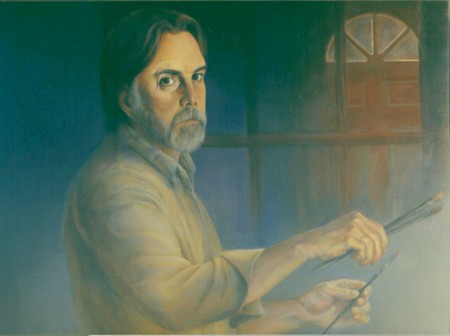
work I have sought to portray the simple dignity of people—to search out the uniqueness,
the 'mannishness' of man. Personality and all that makes man 'man' intrigues me, especial-
ly in the dwindling light of post-modernism.
We live in a world filled with tension and confusion, the quest for equilibrium a natural
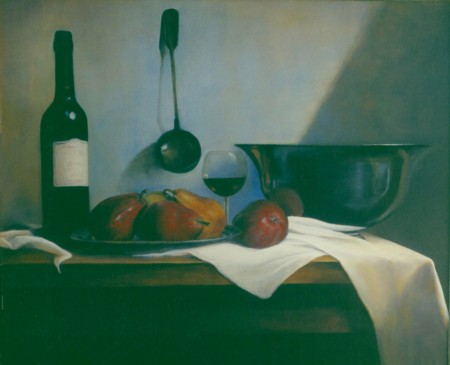
endeavor of the human spirit. Still life painting, it seems to me, should embody just that—
a stillness, a sense of order, balance, and calm.
I paint still lifes, in part, to express a
steadiness and serenity, to create
order and a place where the viewer
can go to rest and reflect.The success
of the paintings should be judged in
their ability to elicit grace, solemnity
and calm. Traditionally, I look back to
the French master Jean-Baptiste-
Simeon Chardin, who invested his
pictures with unique solidity, intimacy
and unpretentious dignity. He painted
with the ability to lift simple people and
common objects into a world of quiet
perfection, fostering a contemplation
of the universal significance of everyday
things.
In our increasingly secular and artificial times, realism paradoxically
can offer a means of transcendence. The viewer's connection to the
reality of a scene can be transformed into a meditation and communion
with the world. To challenge the fundamental isolation of the
individual is a worthy goal of art.
Artist
Statement